Wire/Cannula Protectors
Protect and stabilize needle localization wire to prevent wire migration or movement prior to surgery.
Professional products designed by breast imaging professionals
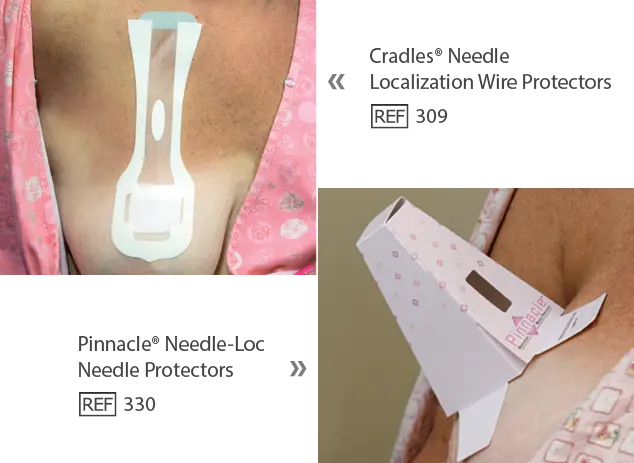
Designed to overcome the shortcomings of makeshift methods used to stabilize the biopsy guidewire by breast care professionals, Beekley Medical's Cradles® needle localization wire protectors and Pinnacle® needle-loc needle protectors provide visibility, secure stabilization, and protection from accidental dislodgement of the guidewire from placement in mammography through removal in surgery.
Both Cradles and Pinnacle have self adhesive edges that make application and removal prior to surgery simple and easy. Cradle's clear cover and Pinnacle's peek-through windows ensure that the guidewire or cannula is visible at all times.
Resources
visit our Educational Center for more
Cradles® Needle Localization Wire Protectors
The clear alternative to gauze and tape
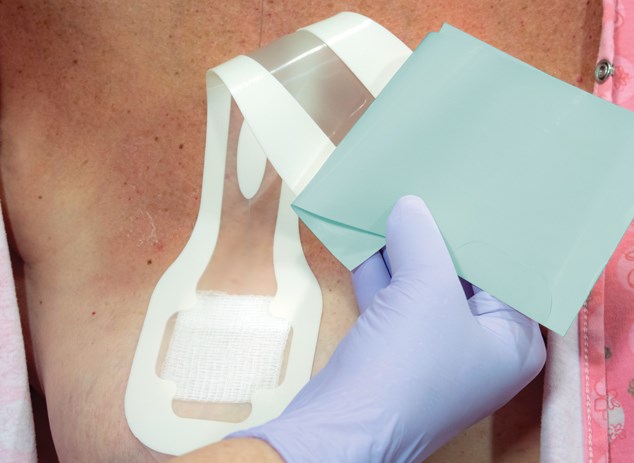
Cradles are clear covers with self-adhesive edges that stabilize and protect the guidewire while the patient is waiting for surgery without hiding it from view.
With the localization wire visible at all times and no adhesion directly over the guidewire, Cradles eliminates the guesswork in surgery, reducing the potential for tugging the wire out of place when removing the wire cover in preparation for surgery.
Wire is visible at all times
Adheres and contours to skin
Secure stabilization of guide wire
Easy to apply and remove
Saves time over makeshift methods
Pinnacle® Needle-Loc Needle Protectors
The professional alternative to coffee cups and tape
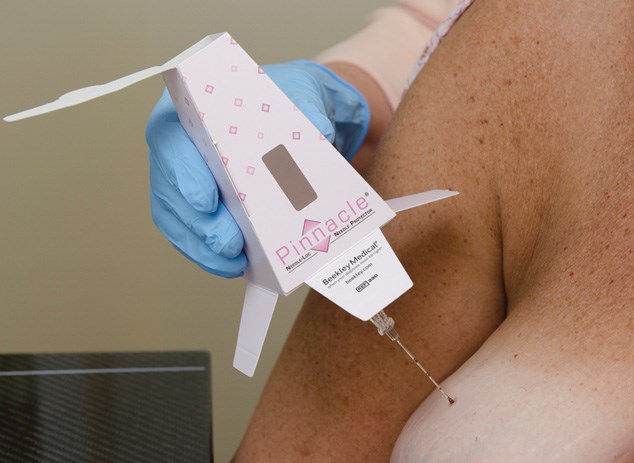
Pinnacle helps protect against movement or accidental dislodgement when the physician requires the needle or cannula to remain in the breast after the needle localization procedure.
Sturdy construction and "just right" adhesive tabs help guard needle against accidental bumps and dislodgement. Peek-through window allows visibility of needle; intuitive design makes Pinnacle easy to apply and remove.
Keeps needle visible
Stays securely in place
Easily withstands accidental bumps
Easy to apply and remove
Saves time over makeshift methods
Complications of Wire Migration after Localization for Lumpectomy
Wire guided localization has been the standard for indicating the location of breast lesions for surgical removal for decades.
It is a well-established safe, effective, and inexpensive procedure that can be performed with local anesthesia in either mammographic, magnetic resonance, or ultrasound imaging – wherever the lesion best images.
However, wire guided localization does have its disadvantages. Aside from coordinating scheduling on the day of the procedure between radiology and surgery, there is the fact that the wire is externally exposed.
Any movement of the guidewire can compromise the accuracy of the localization of the lesions to be surgically removed.
Makeshift methods of protecting the guidewire may do more harm than good
The exposed wire is at risk of being bent, broken, dislodged, or moved out of place while the patient is waiting for surgery.
To help stabilize the guidewire and prevent movement, imaging facilities have employed a variety of practices to protect and stabilize the guidewire.
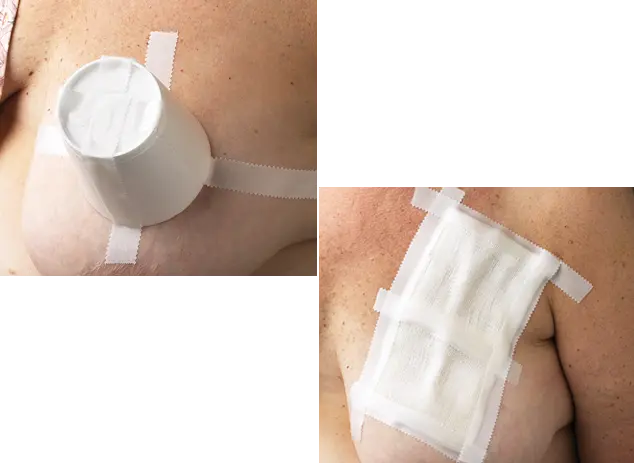
Some facilities will leave the cannula in for additional support of the wire. In some instances, the protruding cannula may be protected by taping a cup to further protect it from accidental dislodgement - although in some cases, the very act of taping the cup down is the reason for needle dislodgement.
More commonly, facilities will cover the wire with gauze and tape it down on the patient's breast.
While this method is more esthetically pleasing for the patient and prevents movement of the guidewire prior to surgery, it has one major drawback – surgical staff needs to remove the gauze before surgery.
With no visibility of the wire through the gauze, surgical staff can unwittingly tug the wire while removing the dressing meant to protect it.
Instructions and Product Safety Resources visit our Educational Center for more
Cradles Instructions for Use
Wire/Cannula Protectors
Protect and stabilize needle localization wire to prevent wire migration or movement prior to surgery.